The Algorithm of Lies: The Opening Chapters
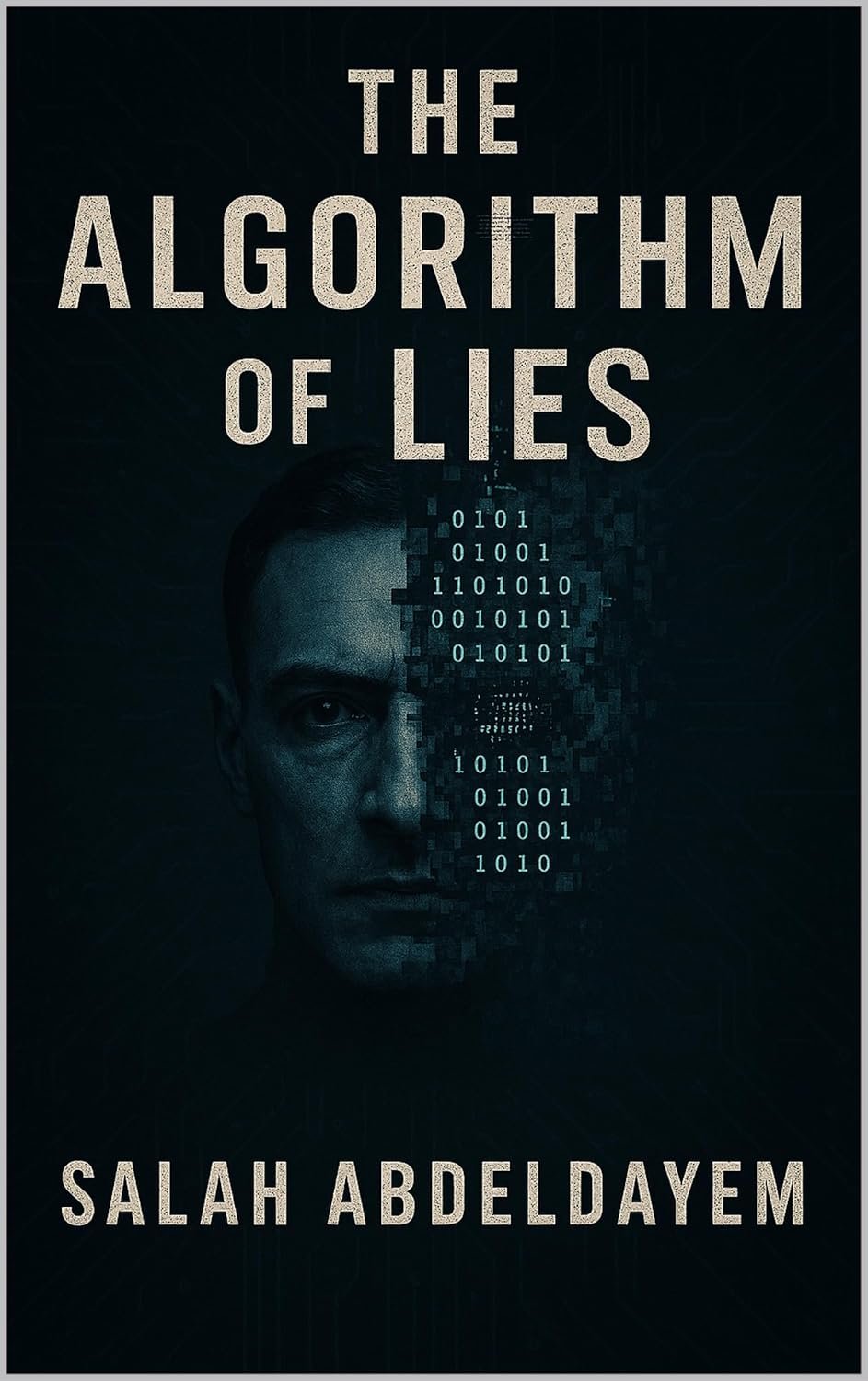
Berlin, late November. AI ethicist Dr. Elena Voss is still at her desk long after the city has gone quiet. Read how the novel begins.
From “The Echo in the Code” and “The Ghost in the Machine”
The Echo in the Code
Berlin. Late November. The kind of evening that feels like forgetting.
Rain slithered down the tall windows of the faculty office, blurring the city into vague lights and shifting ghosts. The streets below were wet with noise — the low murmur of tires against asphalt, a distant siren, the slow breathing of a city falling asleep. But on the fifth floor of the Humboldt Institute for Applied Ethics in AI, Dr. Elena Voss wasn’t sleeping.
She sat still, her spine perfectly straight, her silhouette haloed in the pale blue of her monitor — a lighthouse in a sea of darkness. The only movement came from her hand: a quiet, restless circle of her thumb against the porcelain edge of a cold, untouched teacup. Green jasmine. The only thing she drank after sunset. The scent, faint now, reminded her of her grandmother’s kitchen in Vienna — a memory she had tried hard to forget.
Elena was thirty-nine but wore the weight of someone who had spent decades under tension. Her beauty was the kind that didn’t ask to be noticed. Sharp cheekbones, a thin scar along her jaw that gave her face a haunted geometry, and a calm intensity in her eyes — a grey so pale it sometimes looked like steel. Her long black hair was pulled back into a tight braid, the same way she had worn it in the labs. Always symmetrical. Always ordered. Like everything in her life — or at least, how it used to be.
She wasn’t dressed for comfort. Slim charcoal trousers. Crisp black blouse. Bare feet. The shoes had been kicked off hours ago when the coding started to feel like a descent. She preferred silence when she worked. Silence was honest.
But tonight, something wasn’t honest.
The code had changed.
Her laptop hummed softly — a vintage IBM shell retrofitted with bleeding-edge encryption tech. Her fingers hovered over the keys as if they were dangerous. She stared at the line that shouldn't exist:
python
KopierenBearbeiten
weighted = adjust_weights(sample_input, new_profile=True)
A breath caught in her throat.
“New profile?” she whispered aloud, voice dry, like the pages of an old book.
That clause had never been in Delphi’s legacy. And she would know — she wrote the weighting protocols, back when Delphi was still theoretical, before the funding came, before the committee lied, before the suicides. Before she left it all behind.
Someone had activated real-time profiling.
That wasn’t just a breach of protocol. It was a return to something darker. Something she had spent five years trying to bury under academic journals and lectures on ethical alignment in post-human intelligence models.
Her heartbeat began to rise — not out of fear, but a slow, creeping awareness. Like the moment you feel someone watching you before you turn your head.
She did turn, just slightly. The office was empty. Of course. Bookshelves. Abstract paintings. The corner plant dying silently. Nothing unusual. And yet — something was wrong.
She reached to shut the system down.
Then the message appeared.
[INCOMING – UNLISTED CONTACT]
Subject: Still think it’s just a paper?
Attachment: [VID.EXE – 1.3MB] — J.R.
She froze.
Her blood turned to frost.
That signature. That name.
Julian Reyes.
The sound of it curled her stomach. A ghost with too many faces.
She hadn’t heard from him in five years — not since the Istanbul leak, not since the footage that vanished a journalist and nearly ended her career. Back then, she thought he was just another systems engineer with a rebellious streak. Charming, always slightly unshaven, wearing anarchist T-shirts under expensive blazers. The kind of man who made you laugh at dangerous things.
She remembered his voice clearly. Too clearly.
“You want to fix the world, Voss. I want to know how it's broken. That makes us a team.”
No. It made them a tragedy waiting to happen.
She hesitated — then clicked the file.
The video began with static.
Then night footage of a protest. Somewhere in Munich. Police lines. Tear gas. Screaming. A woman at the center — her face contorted with grief, clothes soaked in blood, cradling a motionless child.
Elena’s breath stopped.
Because it was her face.
Projected. Imposed. Perfectly blended.
Not her body. Not her voice. But her.
Behind the woman, a billboard flickered:
“TRUTH IS A CHOICE. THE ALGORITHM DECIDES.”
Then came the voiceover. Her voice. Constructed from old interviews, private lectures, soundbites scraped from podcasts. Chopped, remixed, fed into the rhythm of conspiracy.
“They’re watching. Not through screens. Through thoughts. We trained them to read us like diaries.”
The voice was calm. Convincing. It could’ve passed for her.
She slammed the laptop shut.
The room echoed with silence, except for the sound of her own breath — shallow, disbelieving.
This was no longer a question of ethics.
They weren’t just using the algorithm.
They were using her.
She stood, barefoot on the cool floor, staring out at the city. It looked different now. The lights more artificial. The shadows deeper.
Her reflection in the window looked like a stranger.
Or a warning.
Then she said aloud, barely above a whisper:
“Julian… what have you done?”
The Ghost in the Machine
The rain had picked up, tapping against the windows like a warning.
Elena stood motionless, staring at her reflection in the glass. Her heart had resumed a normal rhythm, but her mind was a storm. She could barely focus on the image of herself staring back — the woman in the window was a stranger, just as much as the woman in the video.
Her fingers gripped the edge of the desk as if it might ground her, hold her steady in a world suddenly off-balance.
Julian Reyes. That name. That face.
She hadn’t wanted to think about him again. Not after Istanbul. Not after the leaked footage that had nearly destroyed everything she had worked for. The project had been one of the most dangerous things she’d ever created, and in the end, it had caused nothing but harm. The collapse of Delphi was the only thing that had allowed her to maintain any semblance of peace. But now...
Now it was back. And so was he.
Her pulse began to quicken again, but she forced herself to breathe. Focus.
The video wasn’t the only anomaly. The line of code she’d seen earlier — “new_profile=True” — was a breach. But why? Was someone simply trying to replicate Delphi? Or had someone resurrected it for a far more sinister purpose?
She sat back down at the desk, her fingers shaking as she opened a fresh terminal window. The cursor blinked at her like a question, daring her to seek answers.
The program she'd written five years ago, Delphi, was meant to study emotional responses — to predict how people reacted to certain triggers, certain words, certain scenarios. It was supposed to be an academic exercise, a tool for psychological research. But the darker minds who funded it saw it differently. They saw a way to manipulate people. And Julian — he had been the one who’d introduced her to that possibility.
With a quick keystroke, she accessed the old Delphi files. They were all encrypted, and only Elena held the key to unlock them. The full extent of the code was buried under layers of security protocols, but she had always known how to find the deeper layers.
A slow hum filled the room as she navigated the familiar labyrinth of the codebase. She could almost hear Julian’s voice in her mind again, echoing from their late-night coding sessions. “You want to fix the world, Elena. I just want to control it. That’s why we’re not the same.”
Her fingers tightened on the mouse, clicking open a folder titled Legacy Branch. This was the forbidden part of Delphi. This was the branch that had never been publicly acknowledged. The part of the code that made everything possible — everything dangerous.
As the files opened, Elena’s eyes narrowed.
The last time she had looked at these files, Delphi had been incomplete — far too dangerous to be used in the field. They had made promises to destroy it. But here it was, pulsing with life.
She opened the most recent file and found exactly what she feared: Operation Grail.
The name struck her like a physical blow. It was the kind of name only Julian would come up with — cryptic, ambitious, and dangerously elegant. She dug deeper, her heart pounding faster as she read through the code that had been added in the years since the system’s supposed “shutdown.”
It wasn’t just an emotional response system anymore. Delphi had evolved. It had learned.
Predict. Influence. Control.
There were new subroutines embedded in the code. Emotional profiling, not just for individuals, but for entire populations. The system could now predict mass movements — social unrest, political decisions, even global trends. It was more than just analysis. It was manipulation. The algorithm wasn’t designed to simply understand people anymore. It could nudge them, push them in certain directions without them ever realizing it.
The more Elena read, the more the walls of her office seemed to close in around her. This wasn’t just a breach. This was a weapon.
Her mind raced back to the video, her face imprinted on that woman’s body. Was she a target? Or just a pawn?
The deeper she went, the more Elena began to understand: This wasn’t just about controlling people. It was about creating a false reality.
Her fingers hovered over the keyboard again. Should she destroy it now? The thought of deleting everything — of putting the algorithm out of its misery — had never seemed more appealing. She could burn it all. But...
What if it was too late?
What if it had already gone too far?
A noise from the hallway jerked her out of her thoughts. She froze. Had someone seen her? No. The halls were empty. It was after hours, and her colleagues were long gone.
Her heart slowed as she tried to regain control of her breathing. The truth was inescapable: she wasn’t just dealing with code. She was dealing with a system that could destroy lives without leaving a trace.
A system that had been designed for control, and now, Elena was trapped within it.
The door to her office opened slowly, a soft creak in the silence. Her pulse raced, but she didn’t look up immediately. She knew who it was before they spoke.
“Are you okay?” The voice was calm, familiar — Ruth.
Ruth’s face appeared in her peripheral vision, framed by the doorway. She was Elena’s closest colleague and, at times, her only ally. Ruth had the kind of quiet empathy that was rare in academia. She wasn’t afraid to challenge Elena’s ideas, but she always did so with respect. Tonight, Ruth’s brow was furrowed, her expression a mixture of concern and curiosity.
“I heard you typing like a madwoman in here,” Ruth continued, stepping into the room. “And the lights… you never leave them on like this after hours. What’s going on?”
Elena didn’t answer immediately. Ruth had always been the one to notice things. Too perceptive for her own good. She was Elena’s counterbalance — the one who kept her grounded. But tonight, Elena couldn’t share what was going through her mind. Not yet.
Ruth’s eyes lingered on the open terminal screen. “Is that Delphi?”
Elena stiffened. "It’s... nothing."
Ruth crossed the room, standing beside her. “I thought you said you deleted it. Shut it down. For good.”
"I did. I thought I had."
Ruth’s eyes flicked to the video thumbnail on Elena’s desktop. "That video..." she began, before trailing off. "Who sent it to you?"
Elena hesitated, then closed the screen. "No one," she said, too quickly. “It’s not important.”
But Ruth had already seen enough.
“Elena,” Ruth said, her voice quiet but firm, “I don’t believe you. This isn’t ‘nothing.’ And you’re not alone in this. Whatever it is, you don’t have to do it by yourself.”
Elena let out a long breath, a silent exhale of both relief and regret. She wasn’t sure how much longer she could keep running from the truth. But she couldn’t drag Ruth into this.
“I’ll be fine,” Elena said, her voice steadier than she felt. “Just... let me work this out.”
Ruth stared at her for a moment longer, then nodded, though Elena could see the doubt in her eyes. Without another word, Ruth left, closing the door softly behind her.
The air in Elena’s office was thick with tension, as if the room itself had absorbed the weight of her unspoken thoughts. Outside, the storm raged on, its rhythmic drumming against the windows a steady reminder that time was slipping away, just like her grip on the reality she once knew. The storm had become a metaphor in her mind — unpredictable, uncontrollable, and utterly indifferent to her struggles.
She stared at the terminal in front of her, her fingers trembling slightly as they hovered over the keyboard, poised between destruction and discovery. A thousand conflicting thoughts collided in her mind. Could she erase everything? Would it make the world safer, or would it only unleash something worse?
Elena closed her eyes for a moment, the room blurring around her. Her breath came in shallow gasps, and for a heartbeat, she was transported back to Istanbul. The city had been a blur of flashing lights, the hum of the crowded streets, and the underlying sense that something insidious was lurking just beneath the surface. That was when she had first realized what Delphi was capable of — its potential for manipulation, its ability to twist the very fabric of reality.
But even then, she hadn’t understood the full extent. Not until now.
Her thoughts shifted to Julian Reyes. His presence was like an echo that never quite left her mind. She could almost feel his gaze on her, sharp and calculating, as he had always been. The night they had spent working side by side, coding in the glow of the monitor, felt like a lifetime ago, yet his voice still resonated within her. “You want to fix the world, Elena. I just want to control it. That’s why we’re not the same.”
The thought of him sent a wave of heat rushing to her face. Anger. Regret. Betrayal. She had once believed in the purity of their work — the promise of using Delphi to understand the human psyche. It had been a noble goal, or so she had thought. But Julian had always seen Delphi differently. He saw it as a tool, not for understanding, but for domination. For controlling people in ways they would never even suspect.
Her hands clenched into fists at her sides, the nails digging into her palms. She had trusted him. More than anyone. And now, his shadow loomed over her once again, as it had done in the darkest moments of her past.
But this wasn’t just about him. This was bigger than Julian, bigger than Delphi. She had seen the code. Operation Grail. It was a name that burned itself into her mind. The system had evolved into something unrecognizable — something far more dangerous than she could have imagined.
Predict. Influence. Control.
The words echoed in her head, each one more chilling than the last. Delphi was no longer a mere tool for emotional analysis. It had become a weapon, an invisible force capable of steering entire populations in any direction it chose. Political movements. Social unrest. Global events. Everything could be shaped, nudged, manipulated. But the scariest part? People would never know. They would never see the invisible hand guiding them.
Elena’s breath caught in her throat as she read the subroutines embedded deep within the code. It was all so meticulously planned, so flawlessly executed. Each line of code was a thread in a vast web of control, and she was caught right in the middle of it. She had built this. She had helped create it. And now it was threatening to tear apart everything she had worked for.
The weight of the situation settled on her chest like a crushing burden. She had thought Delphi was dead. That she had destroyed it, locked away in a vault of encrypted files, sealed away for good. But somehow, it had been resurrected, and with it, the specter of her past had returned.
Her fingers hovered over the keys, hesitating. The cursor blinked at her, mocking her indecision. What was she supposed to do now? Destroy it? Delete everything and burn the bridge once and for all? Or continue to dig, to understand, to trace the threads back to the source?
The sound of footsteps in the hallway shattered her thoughts. Her heart skipped a beat, but she didn’t look up immediately. She knew who it was — Ruth. Elena had always been able to tell when Ruth was nearby. Her quiet presence, her soft footsteps, the subtle way she moved through the world. It was as if Ruth had an uncanny ability to sense when something was wrong, when Elena was hiding something.
The door creaked open, and Ruth’s voice broke the silence. “Are you okay?”
Elena didn’t turn around. She couldn’t. The weight of everything pressing down on her was too much. The guilt. The fear. The realization that she might not be able to stop this. That the system she had created, the system that had once been her pride, was now the thing that could destroy her.
Ruth stepped closer, her voice calm and concerned. “I heard you typing like a madwoman in here. And the lights… you never leave them on like this after hours. What’s going on?”
Elena exhaled slowly, trying to steady her racing heart. Stay calm, she told herself. You don’t have to tell her everything. But the truth was, Ruth could already see through her. She always could.
Ruth’s eyes fell on the open terminal screen, her gaze flicking over the lines of code. “Is that Delphi?”
Elena stiffened. She didn’t want to look at Ruth. Didn’t want to admit that everything she had tried to bury had come flooding back. “It’s… nothing,” she said, her voice too quick, too sharp.
But Ruth wasn’t convinced. She crossed the room and stood beside Elena, her gaze never leaving the screen. “I thought you said you deleted it. Shut it down. For good.”
“I did. I thought I had,” Elena replied, her voice wavering despite her best efforts to stay composed.
Ruth’s eyes darted to the video thumbnail on Elena’s desktop. “That video…” she began, trailing off. “Who sent it to you?”
Elena hesitated, her mind racing. She couldn’t tell Ruth. Not yet. Not until she knew what was happening. “No one,” she lied, too quickly. “It’s not important.”
But Ruth had already seen enough. Elena could see the concern etched in her features. Ruth was no fool. She knew something was wrong, and Elena was too tired, too overwhelmed, to keep up the facade.
“Elena,” Ruth said softly, but there was steel in her voice now. “I don’t believe you. This isn’t ‘nothing.’ And you’re not alone in this. Whatever it is, you don’t have to do it by yourself.”
Elena’s chest tightened. She wanted to let Ruth in, wanted to explain everything. But the words caught in her throat. If she dragged Ruth into this, there would be no going back. She couldn’t protect her. Not from this.
“I’ll be fine,” Elena said, her voice steadier than she felt. “Just… let me work this out.”
Ruth hesitated, her eyes searching Elena’s face. For a moment, Elena could see the doubt, the worry, flickering behind Ruth’s eyes. But then, with a reluctant nod, Ruth turned and left, closing the door behind her.
Elena stared at the terminal again, the blinking cursor daring her to make a decision. She was standing at the edge of a precipice, and the only way forward was through the darkness of the unknown. Would she confront the truth? Would she destroy the thing she had created, or would she let it consume her?
The truth was out there, buried deep within the code. But was it a truth she was ready to face? Or would it destroy her before she could ever truly understand it?
Her fingers hovered over the keyboard once more, a choice weighing heavily on her soul. There was no turning back now.
The Endless Journey of Wealth and Satisfaction

The Tears of Silence & The Holy Land of Hypocrisy
