Coaching Method: The 4-Space Diagnosis Model
A practice-based diagnostic model for coaching: four failure levels explain why people fail to progress despite motivation, knowledge, or qualification.
Coaching Diagnosis System Map
The Coaching Diagnosis System Map
It explains why people fail to make progress despite motivation, knowledge, or qualification. Instead of listing ten separate problems, it traces each one back to one of four possible malfunctions in self-steering: decision, action, impact, or stability.
Book an Intro Call
Four spaces
Ten coaching patterns
Documented in two books
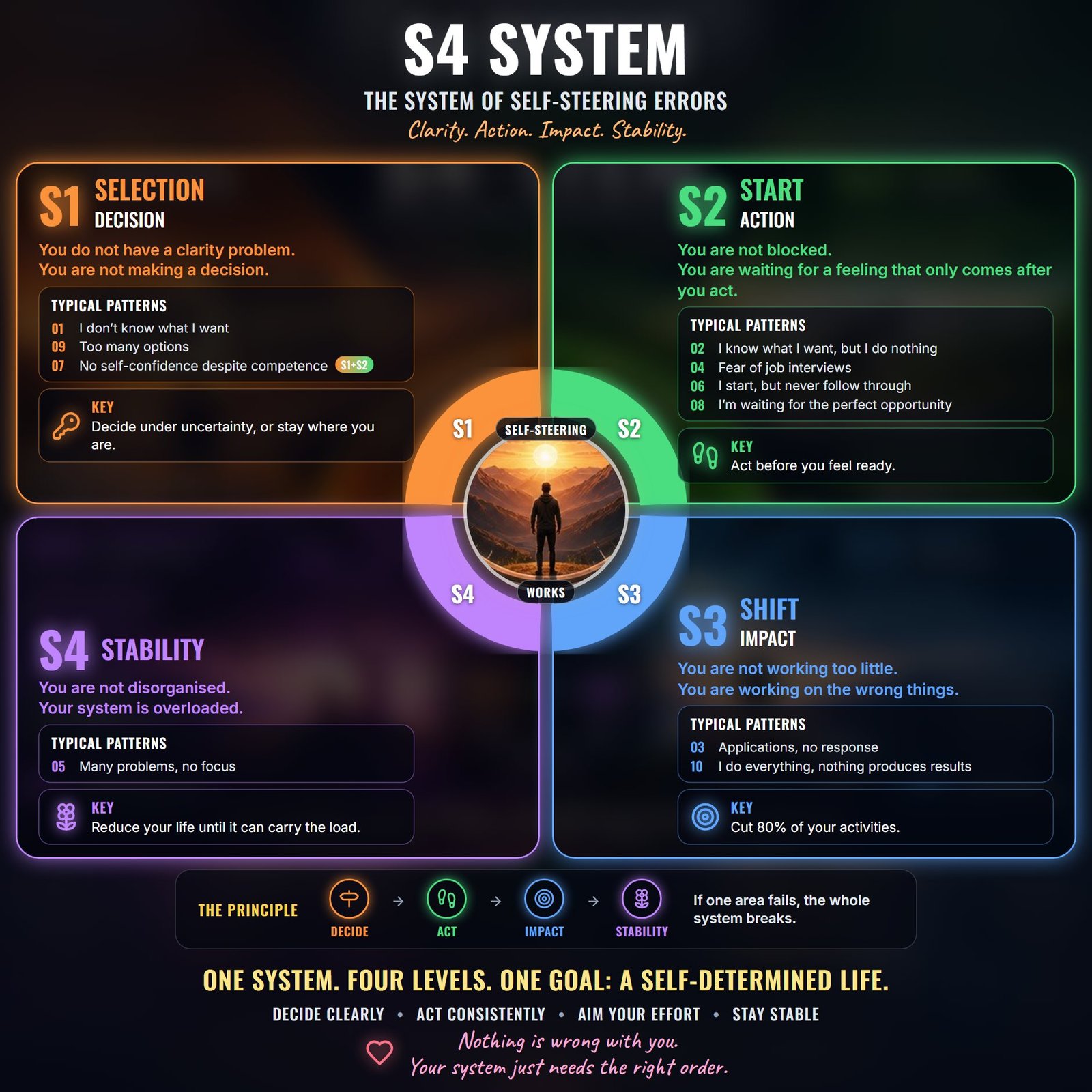
No problem is "a behavior"; every problem is a malfunction in the steering system.
Salah Abdeldayem, The First 10 Real Coaching Patterns
Feeling Stuck? The Real Problem May Not Be Motivation
Most people who feel stuck in a coaching process are not unmotivated. They know their goal, have the necessary skills, and have often already thought, researched, and planned a great deal. Yet nothing moves. This is exactly where the Coaching Diagnosis System Map starts: it is not willpower that is missing, but a specific function somewhere in the chain of decision, action, impact, and stability that is broken.
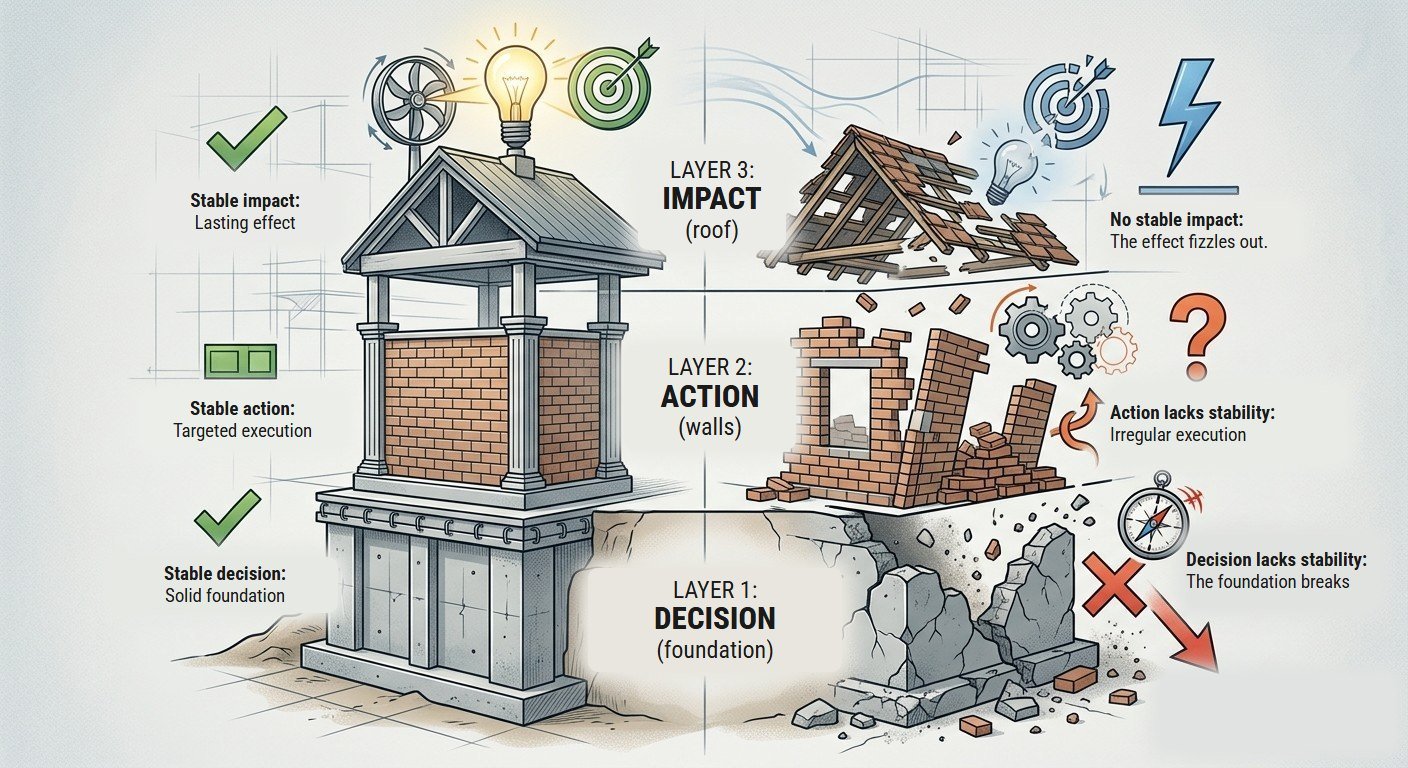
The Four Spaces That Shape Your Decisions
The System Map distinguishes four levels at which self-steering can fail. They can be checked one after another, each with a single key question. The first question answered with "no" marks the affected level, and with it, which kind of intervention can actually work.
Is there clarity about the direction? Otherwise, thinking replaces deciding instead of enabling it.
Explore this space
Is a start actually made? Otherwise, action stays tied to an inner state instead of to reality.
Is there real impact? Otherwise, activity replaces actual impact.
Is everyday life stable? Otherwise, the system is overloaded, not wrongly motivated.
The 10 Coaching Patterns
Each of the four levels shows up in practice in a recurring, concrete way. The book describes ten such patterns, each with its own diagnostic question and its own intervention.
waiting for the perfect moment
lack of focus from everyday chaos
Cross-level
qualification without self-confidence
a perceptual pattern that affects both the Decision Space and the Action Space
Areas of Application
Career reorientation and decision-making
reducing an overload of options to workable alternatives.
Job applications and job search
distinguishing between activity and actual impact.
Execution and goal achievement
translating knowledge into real, completed action.
Focus and daily structure
stabilizing the conditions under which concentration is possible at all.
What This Model Does Not Claim
The System Map is practice-based, developed from recurring observations in coaching work, not from controlled studies. It does not replace a medical or therapeutic diagnosis, and it does not claim that every form of standstill is a malfunction in self-steering: real external obstacles, missing resources, a tight job market, health limitations, remain real, regardless of which space is affected.
About the Method Developer
The Coaching Diagnosis System Map was developed by Salah Abdeldayem and was first presented in its complete form in the book The First 10 Genuine Coaching Patterns. A more detailed exploration of the same underlying model can be found in The 4 Levels of Change, also written by Salah Abdeldayem.
Frequently asked questions
What is the Coaching Diagnosis System Map?
A model from coaching practice that traces standstill back to four failure levels, the Decision Space, Action Space, Impact Space, and Stability Space, instead of to isolated individual problems.
How do you diagnose which space is affected?
Through a sequential check: Is there clarity about the direction? Is a start actually made? Is there impact? Is everyday life stable? The first question answered with "no" marks the affected level.
Who is this model for?
For people going through career change processes, especially around direction, applications, decision-making, and execution, as well as for coaches looking for a structured diagnostic language.
Is this model scientifically validated?
No. It is practice-based, developed from recurring observations in coaching work, not presented as a research result.
Want to find out where you are stuck?
That is what the first conversation is for. It is free, takes 20 minutes, and we look together at whether coaching is the right way to work on it.
© 2026 Salah Abdeldayem. The Coaching Diagnosis System Map is Salah Abdeldayem's own method. Its texts, model, graphics and materials are protected by copyright. Its commercial use, distribution, or application within your own coaching or consulting services is not permitted without explicit written permission and corresponding training from Salah Abdeldayem.