

Between Silence and Pain: Why the Truth About the Middle East Touches Our Humanity
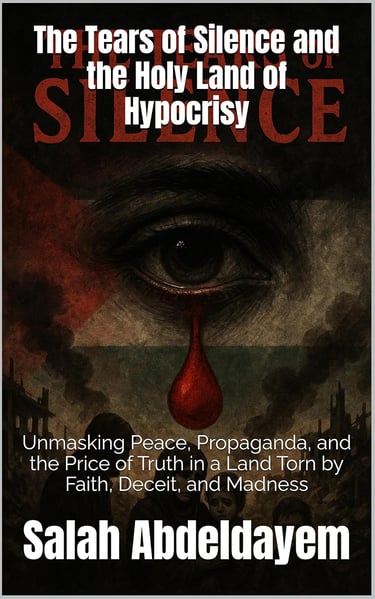
Did you know that remaining silent about what is happening in the Middle East especially in Palestine affects our shared humanity? In his book The Holy Land of Hypocrisy, Salah Abdeldayem explores how language, religion, and politics become tools that distort reality and conceal truth. This article invites readers to confront silence, understand the deep wounds people endure, and reflect on our collective human responsibility and empathy toward those who suffer in silence.
CULTURE AND PHILOSOPHYTHE PHILOSOPHY OF LIFE, AND THE SEARCH FOR MEANING
Salah Abdeldayem
1/28/2024


There are places in this world whose very mention evokes powerful emotions,anger, hope, fear, guilt. The Middle East is one of them, and above all, Palestine.
For some, it is a mere point on the map. For others, a sacred symbol. For many, a political controversy.
But for millions, it is simply home.
In my book “The Holy Land of Hypocrisy,” I seek to break the silence, not only about what is happening there, but about how the rest of the world chooses to respond. The issue is not just occupation, bombs, or bloodshed. It lies deeper in the mechanisms that shape perception: how language becomes a weapon, how faith turns into a pretext, and how political calculation replaces compassion.
What is happening in Palestine is not a conventional war, it is a war of narratives.
A war in which words like “self-defense” and “terrorism” destroy more than bombs ever could.
Who is allowed to defend themselves, and who is labeled “innocent,” is decided not only on the battlefield but in newsrooms, parliaments, and digital algorithms.
In this war, truth is not objective, it is negotiable. And that is the heart of the problem.
Faith can bring comfort and unity, but it can also divide, especially when it is misused.
In this book, I reveal how religious texts have been manipulated by all sides to justify violence, preserve power, and shift blame. When belief stops questioning and starts commanding, it loses its soul.
And when political leaders invoke God’s name to secure their thrones, faith becomes a business.
One of the most painful truths is not only what happens, but how many choose to look away.
International organizations publish reports. Politicians express “deep concern.” Meanwhile, weapons are shipped, trade deals signed, and empty diplomatic statements repeated.
This silence is not neutral, it is a position, a choice, and a form of violence.
Even the Arab world is not blameless.
Palestine has too often been used as a symbol, rarely defended as a living reality.
Solidarity has become performance, and where words grow louder, action disappears.
I did not write this book to assign guilt, but to expose the wounds, not only in the Middle East but within us all.
Because the same patterns of denial, fear, and ignorance live in every society.
This book is a mirror. Those who dare to look into it will not see only Palestine, they will see themselves.
It is about the psychology of silence, the pain passed down through generations, the hatred that is not born but taught, and the questions we avoid because their answers unsettle us.
A call to humanity
“The Holy Land of Hypocrisy” is not a neutral report, it is a call.
To everyone who can still feel.
To everyone who seeks to understand before judging.
To everyone who believes that peace must be more than a word.
Only when we learn to hear the tears of others does the path to true reconciliation begin.
If you wish to understand how deep silence runs, read this book.
Not because it holds all the answers, but because, at last, it dares to ask the right questions.ا.